Inherit the Past. Code the Future. 26-28 May 2026, Svishtov (Bulgaria)
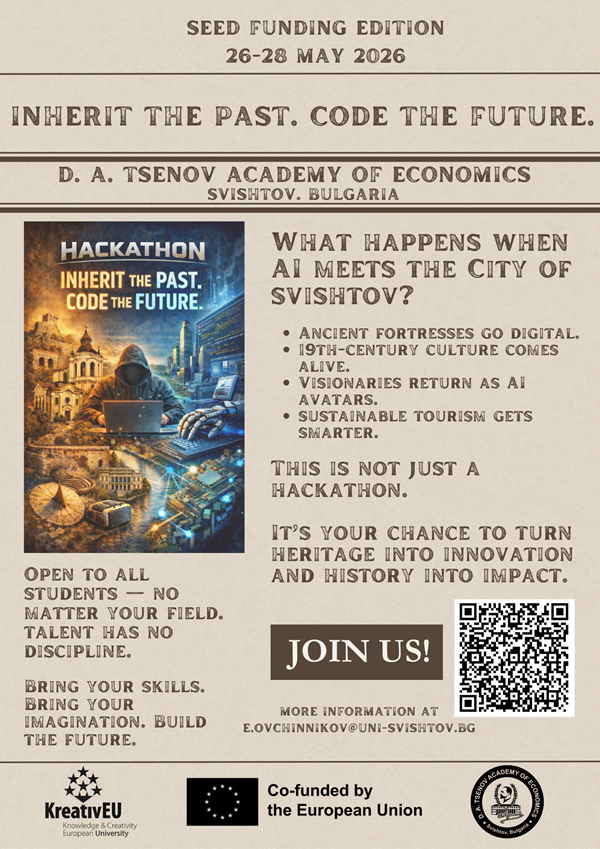
Step into a hackathon where technology meets the heritage of Svishtov.
This is not just another coding competition. It’s your chance to merge AI, creativity, culture, entrepreneurship, and innovation into bold solutions that matter – solutions that are future-ready and rooted in history.
✨ Reimagine ancient fortresses through immersive digital experiences.
🏛️ Bring 19th-century cultural landmarks and architectural icons back to life.
🧠 Create AI-powered avatars of Bulgaria’s greatest benefactors and visionaries.
🌍 Design smart tools that analyse, optimise, and manage sustainable tourism for a modern, data-driven economy.
As part of the KreativEU Alliance, you are more than participants – you are innovators, cultural transformers, and future shapers.
This hackathon challenges you to:
- Think beyond code.
- Build solutions with real-world impact.
- Turn heritage into opportunity.
- Transform history into intelligent systems.
💡 Whether you study economics, arts, computer science, engineering, humanities, business, or design – your perspective matters.
Talent has no discipline.
This is your arena.
Your creativity.
Your impact.
Inherit the past.
Code the future.
This hackthon is a seed-funding competition.
When: |
26-28 May 2026 |
|
Where: |
D. A. Tsenov Academy of Economics |
|
Programme: |
25 May 2026 – Arrival of participants |
|
Registration: |
Deadline: 30 April 2026 Link: Inherit the Past. Code the Future. 26-28 May 2026 – Fill out form QR code: |
|
Information: |

Funded by the European Union. Views and opinions expressed are however those of the author(s) only and do not necessarily reflect those of the European Union or the European Education and Culture Executive Agency. Neither the European Union nor the granting authority can be held responsible for them.