Eric Schöne on the Methodology of Strategic Planning amid Transformations in the Real Estate Sector
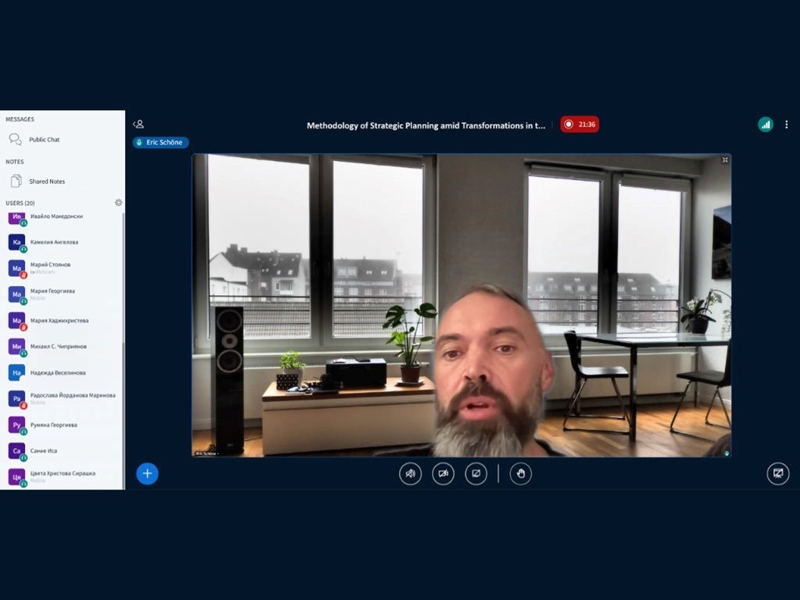
As part of the 70th anniversary of the Department of Strategic Planning, Eric Schöne MRICS was invited as an external guest to the D. A. Tsenov Academy of Economics. At the invitation of Assoc. Prof. Mihail Chipriyanov, PhD, he presented key findings from his research on common-good-oriented corporate planning. His lecture drew both on his academic work at the Institute for Information Systems at the University of Leipzig and on his extensive practical experience in the real estate sector, where issues such as accountability, controllability, and data quality are consistently of central relevance.
At the beginning of his lecture, Schöne situated his topic within a landscape marked by multiple simultaneous transformation processes. Organisations increasingly face complex regulatory requirements and interdependent economic structures. Moreover, ecological, social, and technological developments are becoming more closely intertwined. These factors increase the need for coherent value and decision-making frameworks. Schöne emphasised that his professional experience has repeatedly demonstrated how important transparent, fair, and data-driven decision processes are for operational stability. This raised the question of whether common-good-oriented values can help structure strategic planning processes more clearly.>
In the main part of his lecture, Schöne argued that integrating common-good principles is not at odds with efficiency or economic viability. Rather, such principles can function as complementary analytical instruments. Values such as transparency, participation, and accountability can help reconcile different perspectives within organisations and among stakeholders. In situations where specialist logic or technical parameters do not yield clear decisions, normative guidelines can provide orientation. On this basis, organisations are better equipped to identify risks, define priorities, and align their strategic targets in a coherent and comprehensible manner. Schöne then addressed areas in need of reform within organisations that aim to make consistent common-good-oriented decisions. These include clearly defined governance structures, deliberate approaches to data and system quality, and transparent responsibilities. Coordination, he noted, should rely less on control and more on structured alignment. He explained that modern planning systems frequently depend on indicators, scenarios, and standardised risk models; however, such systems only function reliably when they are supported by valid data and clearly defined processes. His research therefore examines how normative objectives can be optimally aligned with technical systems in order to create a stable foundation for strategic decision-making.

Schöne subsequently turned to the role of digital infrastructures in organisational decision-making. Digital systems can support processes, yet they must be embedded within clear organisational structures. Their quality depends heavily on transparency, data validation, and the willingness to link technical and organisational perspectives. Digitalisation, he argued, should not be viewed in isolation; it is part of a broader decision-making and steering framework. In Schöne’s view, digitally supported models enable a more precise assessment of causal relationships and provide entry points for common-good-oriented considerations. He also highlighted the European context: organisations increasingly operate within cross-border structures and face challenges such as sustainability requirements and supply-chain dependencies. Common-good-oriented corporate planning can contribute to better aligning national approaches and making cooperative practices more comprehensible. Clear value orientations, combined with data-based planning instruments, make it possible to present decisions consistently, both internally and within the broader European framework.
In his concluding remarks, Schöne stressed that common-good orientation should not be understood as an antithesis to corporate objectives. When applied effectively, it supports a more structured analysis of complex issues, clearer articulation of trade-offs, and greater long-term consistency in decisions. The combination of practical experience, scholarly analysis, and a systemic understanding of data-driven processes provides a robust basis for this approach. It becomes evident that common-good-oriented planning is not primarily a normative aspiration, but rather a methodological approach for improving organisational decision quality.
Eric Schöne brings extensive experience in commercial asset management, technical project management, and the development of data-oriented process models. His work includes engagements in both medium-sized organisations and large commercial and residential portfolio operators. He has repeatedly served as an interim project manager during transitional or restructuring phases, where analytically robust, data-driven approaches were essential. As a Member of the Royal Institution of Chartered Surveyors, he combines professional standards with ethical considerations. These perspectives substantially inform his scholarly work and form the foundation of his engagement with common-good-oriented planning models.