CALL FOR STUDENT COMPETITION RE:PLACE – Business Ideas for Small Places Turn Local Challenges into Business Opportunities
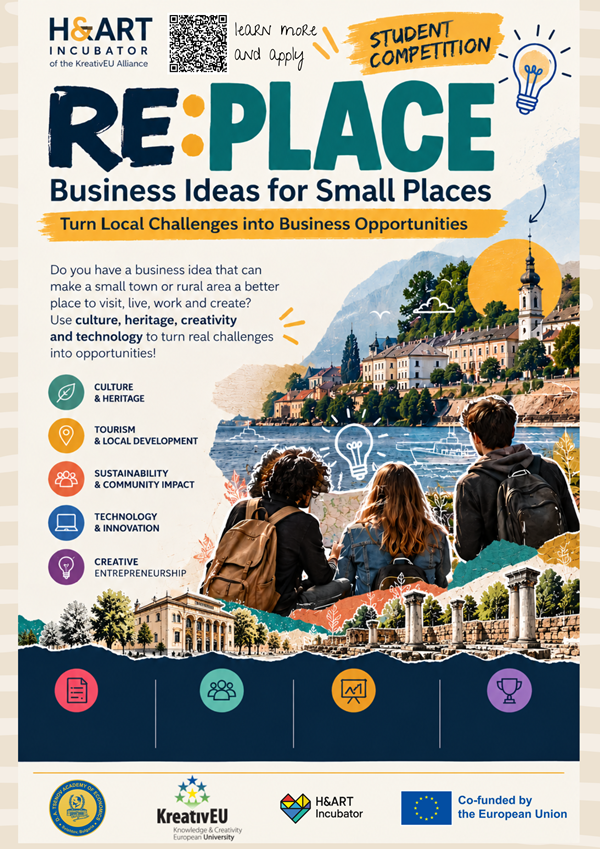
The H&ART Incubator / Local Branch TAE invites students to participate in the Student Competition RE:PLACE – Business Ideas for Small Places.
Do you have a business idea that can make a small town or rural area a better place to visit, live, work and create? Can culture, heritage, creativity and technology help transform a real local challenge into a business opportunity?
RE:PLACE challenges students to identify a real problem, need or opportunity faced by a small town, rural area or other low-density territory and develop an innovative business idea in response.
The Competition is organised within the H&ART Incubator of the KreativEU Alliance and forms part of the KreativEU Seed Funding Initiative. H&ART student competitions aim to foster entrepreneurial thinking and innovation, encourage creative problem-solving, promote solutions to real-world challenges and support ideas with cultural, social, environmental or economic impact.
About the Challenge
Small places have much to offer: cultural and natural heritage, local traditions, stories, skills, creativity, distinctive identities and strong communities. At the same time, they may face challenges such as declining populations, limited economic opportunities, underused cultural and heritage resources, seasonal tourism, weak visitor experiences, limited digitalisation or difficulties in attracting and retaining young people.
RE:PLACE asks you to turn one of these challenges into an opportunity.
Your idea should address one or more of the following areas reflected in the Competition theme:
- Culture and Heritage
- Tourism and Local Development
- Sustainability and Community Impact
- Technology and Innovation
- Creative Entrepreneurship
The proposed solution should have a clear connection with the cultural and creative industries (CCIs).
What kind of idea can you propose?
You may propose a start-up, product, service or other entrepreneurial solution responding to a real challenge or opportunity in a small town or rural area.
Examples may include:
- new cultural or tourism products and experiences;
- innovative ways of using or interpreting cultural heritage;
- digital solutions for cultural sites, visitors, communities or local businesses;
- AI, XR/VR, gamification, digital storytelling or other creative technologies;
- new products or services based on local culture, crafts, traditions or knowledge;
- solutions supporting sustainable tourism and local development;
- creative uses of underused cultural or heritage spaces;
- platforms connecting visitors, residents, creators and local businesses;
- social or creative enterprises responding to community needs;
- other innovative business ideas connecting place, culture, creativity and entrepreneurship.
Technology is encouraged where it contributes meaningfully to the proposed solution. Innovation does not have to be purely technological. It may also be artistic, social or digital.
Who can participate?
The Competition is open to students of the D. A. Tsenov Academy of Economics.
Students may participate individually or in teams. Interdisciplinary and complementary teams are particularly encouraged.
Students are invited to combine the knowledge and competences developed through their studies with their personal interests, talents, experiences and skills. A student of economics, business, marketing, tourism or informatics may also bring knowledge, experience or a strong interest in art, cultural heritage, history, geography, media, design, photography, storytelling, AI and emerging technologies, crafts, music, gaming, sustainability, local traditions, or other creative fields.
Competition format
RE:PLACE will be organised as a one-round competition. The Competition will follow the sequence:
Open Call à Application à Eligibility Check à Mentoring à Pitch Event à Evaluation à Award Ceremony
What do you need to submit?
Applicants must complete the online application form and provide the information requested about their business idea.
The application should clearly explain:
- the problem, need or opportunity identified;
- the proposed business idea/solution;
- the target customers, users or audiences;
- the value the solution would create for them;
- what makes the idea innovative or different;
- how the idea could be implemented;
- how it could create and sustain economic, cultural, social and/or environmental value;
- how the idea relates to the RE:PLACE theme and to the cultural and creative industries.
At this stage, applicants are not expected to have a fully developed business plan, working product or established company. The Competition is designed to support the development and refinement of promising ideas.
Eligibility
To be eligible, participants must:
- be students of the D. A. Tsenov Academy of Economics;
- submit their application within the announced deadline;
- propose an idea fitting the RE:PLACE theme and addressing the cultural and creative industries;
- provide the required Competition materials;
- accept the applicable Competition Terms.
The formal H&ART eligibility check is conducted on a YES/NO basis. If an eligibility condition is not met, the proposal is not scored.
Mentoring
Following the eligibility check, participants will enter a mentoring phase designed primarily to help them prepare an effective pitch.
Mentors will support participants in developing and communicating key elements of their ideas, including the problem-solution fit, target market or audience, feasibility, business model, sustainability, impact and pitch presentation.
Mentoring may include individual mentoring sessions, group consultations, thematic workshops and pitch coaching.
The mentoring team will have a strong European dimension and will represent KreativEU partner universities.
Pitch Event
At the end of the mentoring phase, participants will present their developed ideas during the RE:PLACE Pitch Event.
Participants may use presentation slides and, where relevant, a prototype, demonstration, mock-up, video or other visual material.
All participants will receive the same advance instructions and will have equal presentation and Q&A time.
Pitch format: online
Pitch duration: 10 minutes
Q&A: 5 minutes
Evaluation
Еach proposal will be evaluated based on seven evaluation criteria (S1–S7). Each criterion has a relative weight in the final score.
|
Criterion |
Weight |
|
S1 Innovation and Creativity |
20% |
|
S2 Problem-Solution Fit |
16% |
|
S3 Market Potential / Audience Uptake |
16% |
|
S4 Feasibility and Implementation Plan |
16% |
|
S5 Business Model and Sustainability |
11% |
|
S6 Social / Environmental Impact |
11% |
|
S7 Presentation and Communication (Pitch) |
10% |
Each criterion is scored on a 0–5 scale, from Not addressed / No evidence to Excellent / Outstanding. The score for each criterion will be multiplied by its respective weight, and the sum of the weighted scores will determine the final score and ranking.
The Evaluation Panel will consider not only how original the idea is, but also whether it responds convincingly to a real problem, has a credible target market or audience, can realistically be implemented, has a sustainable model and creates meaningful impact. Small-scale ideas can score highly where their local or community-level impact is tangible and well thought out.
Evaluation Panel
The proposals will be evaluated by a transnational Evaluation panel. The Evaluation panel will include representatives of KreativEU partner universities, as well as experts from associated partners and external stakeholders to provide complementary expertise.
The evaluation and selection of winners will be conducted in accordance with the principles of transparency, fairness, efficiency, non-discrimination and equal treatment.
Seed Funding Prizes
The best ideas will receive seed funding prizes. Seed funding is awarded to winners in the form of cash prizes.
Certificates and Further Opportunities
Participants who successfully complete the Competition may receive a Certificate of Participation, while the winners will receive Award Certificates. Promising participants may also be invited to explore opportunities for the further development of their ideas within the H&ART Incubator, including incubation, mentoring, networking and other H&ART activities.
Intellectual Property and Competition Terms
All intellectual property rights relating to ideas, products, services, start-up concepts, prototypes and other outputs developed for the Competition remain with their creators. Participants retain the right to further develop, commercialise, license or otherwise exploit their proposals after the Competition.
By registering for the Competition, participants accept the applicable Competition Terms, including provisions concerning intellectual property, confidentiality and third-party content. Participants must ensure that submitted work is original and that any third-party materials are appropriately licensed or cleared.
Working language
The working language of the Competition is English.
Timeline
Call opening: 02/10/2026
Application deadline: 22/11/2026
Eligibility check and notification: 23/11/2026
Mentoring period: 24/11/2026 – 09/12/2026
Pitch Event and Final Evaluation: 10/12/2026
Award Ceremony: 11/12/2026
Application process
Applications are submitted through:
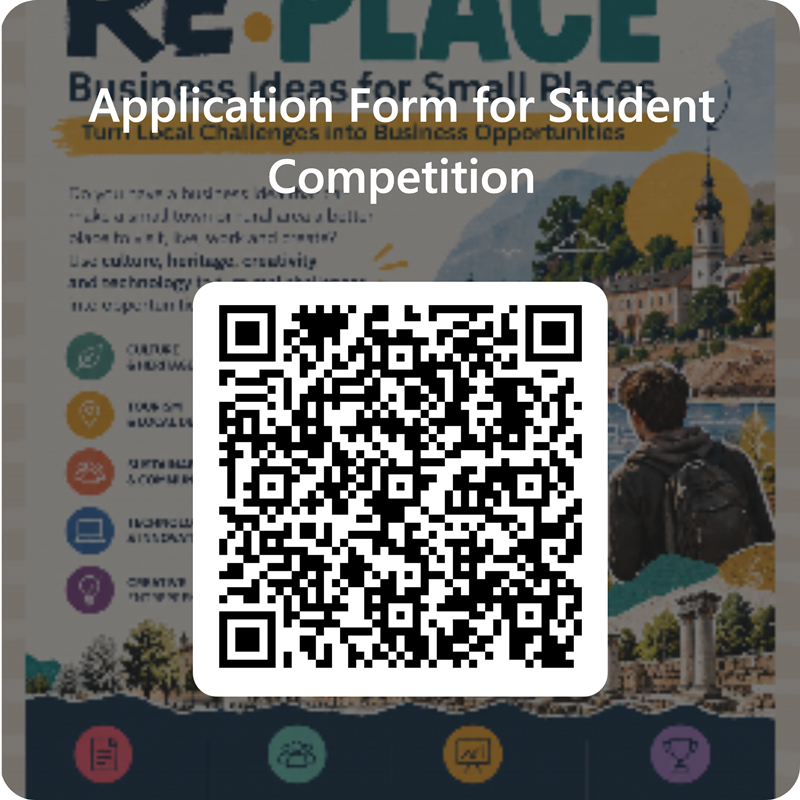
Online application form:
Application Form for Student Competition – Fill out form
QR code:
All applicants will be informed by email about the outcome of the eligibility check and the next stage of the Competition.
Contact and further information
For further information about the Competition, please contact:
H&ART Incubator / Local Branch TAE
Email: heart.incubator@uni-svishtov.bg
Think local. Create value. RE:PLACE.
Turn a local challenge into a business opportunity.
.png)
Funded by the European Union. Views and opinions expressed are however those of the author(s) only and do not necessarily reflect those of the European Union or the European Education and Culture Executive Agency (EACEA). Neither the European Union nor EACEA can be held responsible for them.